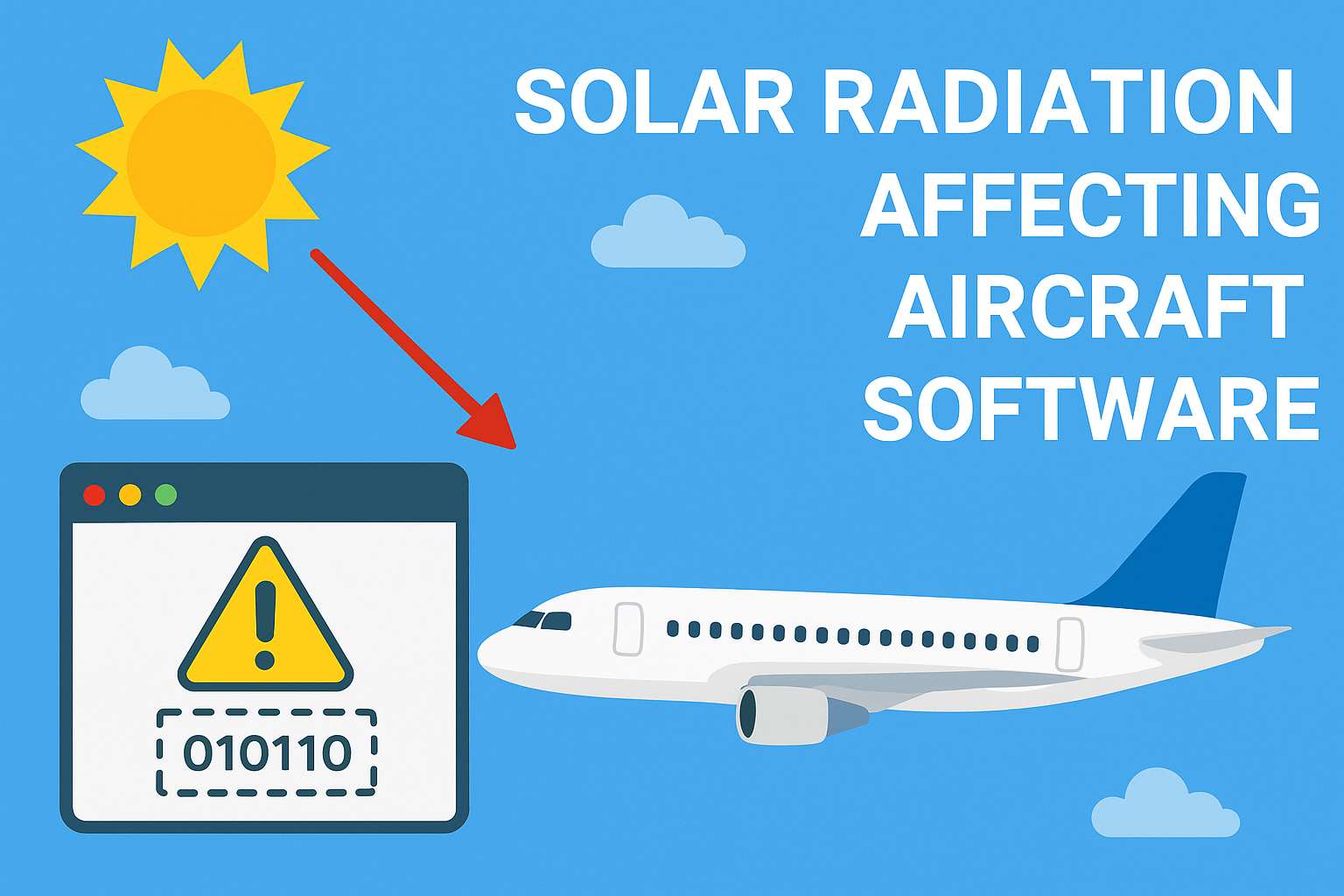
Understanding the Airbus Software Issue in Simple Terms
Recently, multiple flight cancellations were reported due to a software issue affecting Airbus aircraft.
While “software problems” may sound abstract, the underlying cause is both fascinating and important:
solar radiation and its impact on onboard computer systems.
In this article, we will explain:
- What solar radiation is
- How it can corrupt digital data
- Why aircraft systems are affected
- How the aviation industry prevents such problems
All explained in clear, non-technical language.
☀️ What Is Solar Radiation?
The Sun constantly emits not only light and heat, but also high-energy particles, such as:
- Protons
- Neutrons
- Electrons
During periods of strong solar activity, these particles travel toward Earth.
Most are blocked by Earth’s atmosphere and magnetic field—but at cruising altitude (around 10–12 km), aircraft are far more exposed than systems on the ground.
💻 How Computers Store Data
Aircraft computers work just like regular computers:
- All information is stored as binary data
- Binary data consists of 0s and 1s
- These values are represented by tiny electrical charges inside memory chips
Because modern electronics are extremely small and efficient, even a very small electrical disturbance can change a value.
⚡ What Is a “Bit Flip” (SEU)?
When a high-energy particle hits a semiconductor, it can momentarily disturb the electrical charge inside a memory cell.
This may cause:
- A 0 to become a 1
- Or a 1 to become a 0
This phenomenon is called:
SEU (Single Event Upset)
also known as a bit flip
The data is not erased—it is silently altered, which makes it particularly dangerous.
🚨 Why a Single Bit Matters in Aviation
If a corrupted bit affects:
- Aircraft attitude data
- Speed or altitude calculations
- Sensor fusion logic
- Flight control commands
the software may:
Treat incorrect data as correct
and respond automatically
This can lead to:
- Sudden pitch or roll corrections
- Unexpected altitude changes
- Autopilot disengagement
Even if pilots regain control, such events are taken extremely seriously.
🛡️ How Aircraft Prevent Radiation-Related Errors
Aircraft are designed under the assumption that failures will happen.
Safety is ensured through a three-layer defense system.
🧱 1. Hardware-Level Protection
- Radiation-tolerant processors
- ECC (Error-Correcting Code) memory
- Triple-redundant computers
If one system produces an abnormal result, it is outvoted or ignored.
🧠 2. Software-Level Protection
- Plausibility checks (rejecting impossible values)
- Cross-checking multiple sensors
- Watchdog timers to detect freezes or crashes
- Fail-safe logic (system defaults to a safe state)
In many cases, the system will simply disengage automation and return control to the pilot.
✈️ 3. Operational Protection
Airlines also manage risk operationally by:
- Monitoring space weather forecasts
- Avoiding high-latitude routes during solar storms
- Adjusting altitude when radiation levels increase
These measures reduce exposure before it becomes a technical problem.
🛠️ What Happened in the Airbus Case?
In the recent Airbus situation:
- A rare in-flight anomaly revealed a software vulnerability
- The issue involved how corrupted data was handled
- Airbus released a software update to improve detection and response
Until updates were applied, airlines temporarily grounded affected aircraft—a precautionary safety measure, not an emergency reaction.
✅ Final Thoughts
Solar radiation affecting computers may sound alarming, but in reality:
- The phenomenon is well understood
- Aviation systems are designed to handle it
- Temporary flight cancellations reflect strong safety culture, not danger
In aviation, stopping flights early is considered success—not failure.
✨ Key Takeaways
- Solar radiation can flip digital bits at high altitude
- Even one bit error can matter in flight control systems
- Aircraft use layered defenses to detect and neutralize errors
- Software updates further reduce already rare risks